

Is This the Ultimate Push-Pull Self-Latching Solution for Your Indoor Coaxial Applications?
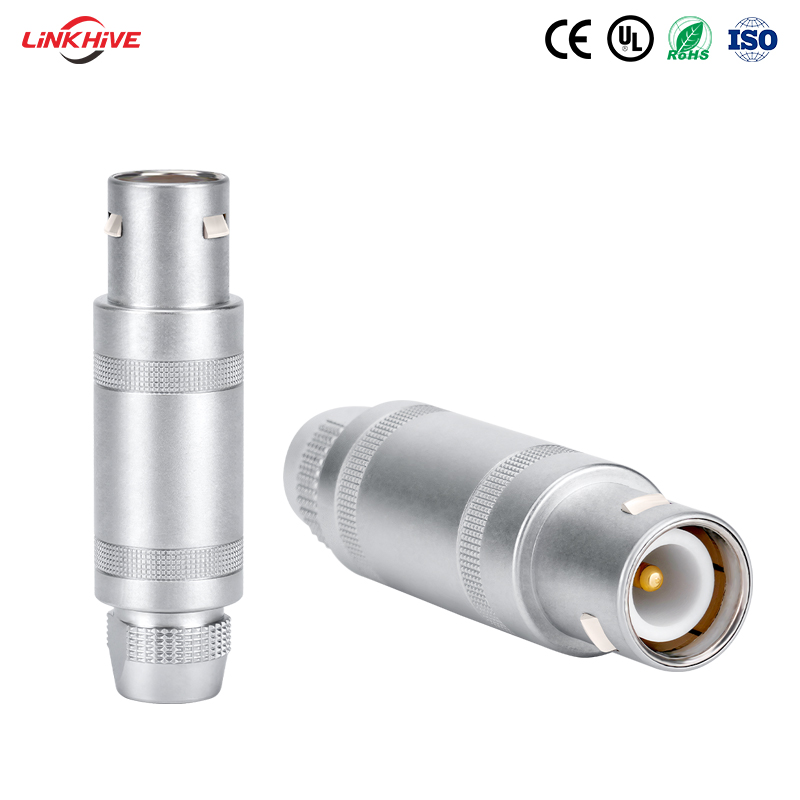
Redefining Reliability: How Single-Core Coaxial Indoor Push-Pull Self-Latching Connectors Are Solving Industry Pain Points
In the fast-paced world of broadcast, medical equipment, test instrumentation, and high-density telecommunications, professionals face a common dilemma: how to secure critical signal integrity without sacrificing speed and ease of use. Traditional screw-type or bayonet connectors, while reliable, often become bottlenecks in high-density panels or tight indoor spaces. Enter the Single-Core Coaxial Indoor Push-Pull Self-Latching Connector—a solution engineered to answer the industry's call for "faster, smaller, stronger."
The "Click" That Guarantees Certainty
Unlike conventional connectors that require threading or multiple rotations, the push-pull self-latching mechanism offers a revolutionary user experience. A simple, linear push engages a precision-engineered latching system that provides a tactile "click," confirming a secure, vibration-proof connection in an instant. Disconnection is equally intuitive—a simple pull on the knurled sleeve releases the latch without damaging the cable or the panel interface.
For indoor environments where space is at a premium—such as in 19-inch rack units, portable camera control units (CCUs), or densely populated I/O panels—this design reduces mating and unmating time by up to 70%. This efficiency minimizes downtime and lowers the risk of accidental disconnection during critical operations.
Uncompromised Signal Integrity in a Compact Form
While the mechanical design prioritizes speed, the electrical performance remains uncompromised. These single-core coaxial connectors are designed to maintain 50Ω impedance consistency, ensuring excellent return loss and minimal insertion loss up to high frequencies (typically ranging from DC to 6 GHz or beyond, depending on the series).
Key performance features include:
Low Contact Resistance: Precision-machined contacts (often gold-plated) ensure stable transmission and resistance to corrosion.
EMI Shielding: The all-metal housing provides robust electromagnetic interference (EMI) shielding, safeguarding sensitive signals in electrically noisy indoor environments.
Durability: With a minimum of 5,000 to 10,000 mating cycles, these connectors are built for the high-wear environments of broadcast studios and testing labs.
Why Indoor Applications Demand This Design
For engineers and system integrators, the decision to switch to push-pull self-latching connectors is often driven by three specific indoor scenarios:
High-Density Patching: In audio/video broadcast trucks or server rooms, where technicians need to reconfigure cabling rapidly, the blind-mate capability of push-pull connectors reduces human error.
Rack-Mounted Equipment: The axial (straight) or right-angle designs save significant front-panel space compared to bulky threaded connectors.
Test & Measurement: In laboratory settings where devices under test (DUTs) are frequently swapped, the self-latching feature preserves the integrity of the test port by eliminating the torque stress associated with screw-on connectors.
Versatility Across Industries
Modern indoor single-core coaxial push-pull connectors are not limited to a single industry standard. They are available in various series (such as the widely adopted 1S, 2S, or B series form factors) that support:
4K/8K Broadcast Cameras: Reliable transmission for SDI (Serial Digital Interface) signals.
Medical Devices: Secure connections in patient monitoring equipment where accidental snagging could lead to critical failures.
Aerospace & Defense Simulators: Secure, high-cycle connections for indoor training equipment.
Conclusion: The Future of Indoor Connectivity
When asking, "Is this the ultimate push-pull self-latching solution for indoor coaxial applications?" the evidence points to a definitive yes. By merging the robustness of traditional coaxial transmission with the ergonomic efficiency of a push-pull latching system, this connector series addresses the core demands of modern indoor electronic systems: reliability, density, and speed.
For design engineers and procurement specialists looking to upgrade their interconnect strategy, the single-core coaxial indoor push-pull self-latching connector is not just an alternative—it is the new standard for mission-critical signal transmission.
For more technical specifications or to request sample kits, please contact [Linkhive] to see how this series can streamline your next-generation indoor equipment design.